A roof's year, from the Newark gauge
Looks to take on a Colonia roof, season by season
The weather figures here are NOAA's 1991-2020 normals for the Newark airport station, the one this site uses, and they may differ at your address. Each look can be done from the lawn, a window or the attic hatch.
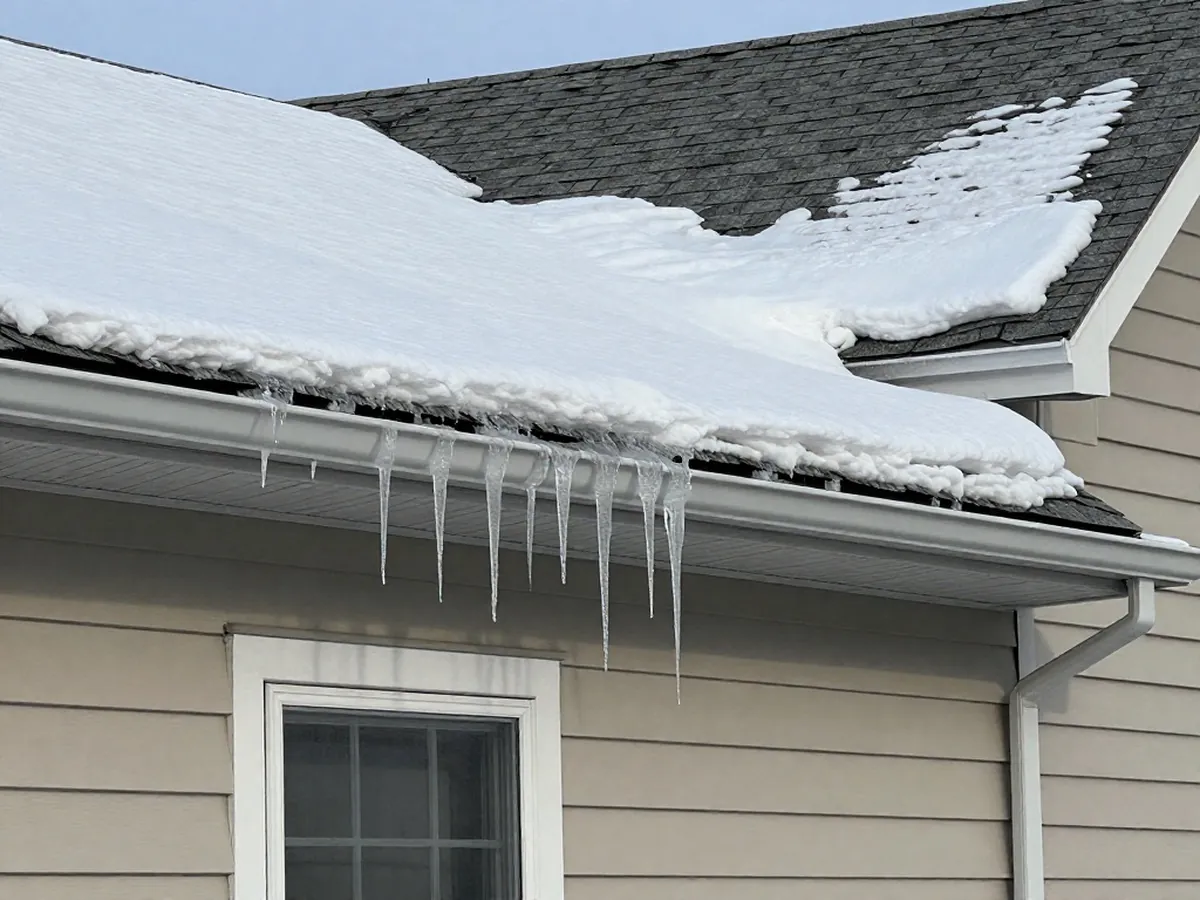
January to March: frozen nights and thaw stains
Newark's normals count 22.6 nights at or below 32 degrees Fahrenheit in January, 20.0 in February and 12.4 in March, with 9.1, 10.1 and 5.6 inches of snow. UMass lists snow, heat and cold as the three ingredients of an ice dam. These are the months to look from the ground at the eaves for a ridge of ice, and at the ceilings for stains that show on thaw days. Photograph both with a date. At the attic hatch, frost on the roof boards is worth noting.
April and May: rain on a winter-worn roof
April averages 3.87 inches of precipitation and May 3.97, and the last freezing nights, 1.2 of them, come in April. The first dry weekend is the time for a walk around the house: shingle pieces in the beds, a gutter sagging after the winter, a downspout pulled from the wall. FEMA's shingle sheet has tabs checked for sealing after sun exposure activates the sealant, so a gap in the pattern after the first warm days is one to photograph.
June to August: heat, and the wettest month
Days at or above 90 degrees average 5.4 in June, 11.3 in July and 7.4 in August, and July is also the wettest month in the normals, at 4.66 inches. On a flat section, the Asphalt Roofing Manufacturers Association counts water still sitting there after 48 hours or more as ponding, so the check is a look two days after a heavy rain. Note which storms bring a stain indoors and which do not.
Notes from the sources
- NOAA NCEI, 1991-2020 monthly normals, Newark Liberty International Airport (USW00014734)
- Asphalt Roofing Manufacturers Association, Ponding water basics (2017)
Checked 1 Nov 2026
September to November: gutters before the first frost
September's 3.82 inches and October's 3.79 arrive before the first freezing nights, 0.1 in October and 6.0 in November. A gutter packed with leaves spills over its front edge, and a look during a rain shows where. According to Rutgers, a one-inch rain over an 800-square-foot roof adds up to roughly 500 gallons, and a single downspout may carry all of it. PSE&G says to leave a tree that is tangled in wires alone and to call 911 or the utility.
December: snow load and wind on loose edges
December averages 17.5 nights at or below freezing and 5.4 inches of snow. The January 2016 storm left 19.0 inches at Woodbridge by a trained spotter's measure, and the storm of 16-17 January 2022 brought a 66 mph gust to Hopelawn. Snow sitting on a roof and wind working at a loose edge are the two things to photograph, before the weather and after it.
All year: one folder of photos and receipts
New Jersey's insurance department asks homeowners with storm damage to photograph property before disposing of it, make temporary repairs and keep every receipt. A folder holding one dated photo of each slope from the lawn, taken each season, gives a roofer something to compare against.
Notes from the sources
Checked 1 Nov 2026
Calling in
Jot down the address, how old you think the roof is and what you can see from the lawn. Then call (732) 568-2812. In a rental, the landlord or the property manager is who you phone first. Calls cover Colonia, Iselin and Edison.